

NBAA Secures Third Place in National AI Hackathon on Renewable Energy

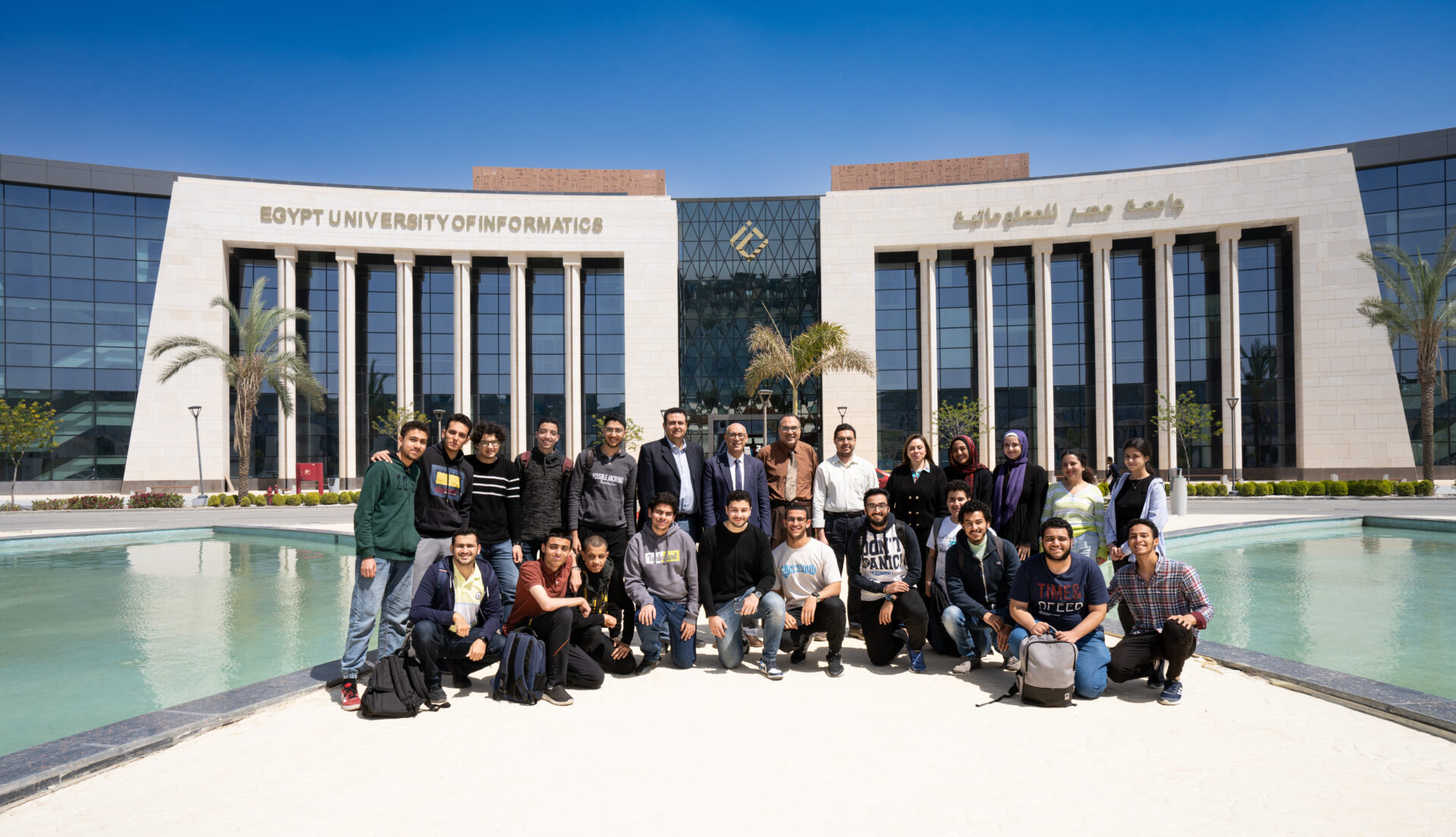
Team NBAA, from the Faculty of Computing and Information Sciences secured third place at a national artificial intelligence hackathon focused on the new and renewable energy sector, held as part of the closing ceremony of the fourth round of Egypt's University Capacity-Building Initiative in Artificial Intelligence. The team was honored on stage alongside the top two winners by Egypt's Minister of Communications and Information Technology, Eng. Raafat Hindi; the Minister of Higher Education and Scientific Research (and Acting Minister of Culture), Dr. Abdelaziz Konsowa; and Dell Technologies' Vice President for Central and Eastern Europe, the Middle East, Turkey, and Africa, Eng. Mohamed Amin.
The hackathon brought together 105 students organized into 21 teams from ten universities, with ten teams advancing to the final round. The event was held at the Creativa Digital Egypt Creativity Center in Giza, marking the culmination of the fourth round of the University Capacity-Building Initiative in Artificial Intelligence — a program launched by the Ministry of Communications and Information Technology in partnership with Dell Technologies to build AI skills and drive innovation among Egyptian university students.
This round of the initiative trained 1,090 students from 10 public, private, and national universities, including Cairo University, Ain Shams University, the American University in Cairo, the German University in Cairo, the Arab Academy for Science, Technology and Maritime Transport, the Egypt-Japan University of Science and Technology, Assiut University, Mansoura University, Alexandria University, and Egypt University of Informatics. Participants completed 445 projects spanning smart agriculture, smart traffic, smart government, digital healthcare, and the smart economy.
Minister Hindi said the initiative's continued growth reflects the success of a partnership model linking government, academia, and the private sector, connecting academic knowledge with real-world application needs. He noted that this year's hackathon theme — new and renewable energy — was chosen for its national importance, strong career prospects for participants, and potential for real societal impact, particularly in areas like production and demand forecasting, grid management, and resource efficiency.
Minister Konsowa praised the ongoing collaboration with Dell Technologies and pointed to the ministry's broader push to transform Egyptian universities into "smart universities," including plans to establish university-based Technology Parks to convert research and innovation into industrial and economic ventures.
Since its launch, the initiative has trained a total of 2,710 students and supported 763 AI-related projects. This year also introduced a new tripartite agreement between the Ministry of Communications and Information Technology, Dell Technologies, and AstraZeneca Egypt, focused on AI applications in healthcare, with AstraZeneca providing mentorship, workshops, and healthcare datasets to support student projects.
Senior officials in attendance included Eng. Ghada Labib, Deputy Minister of Communications and Information Technology for Institutional Development, along with representatives from the New and Renewable Energy Authority and several partner universities.